Maleisië
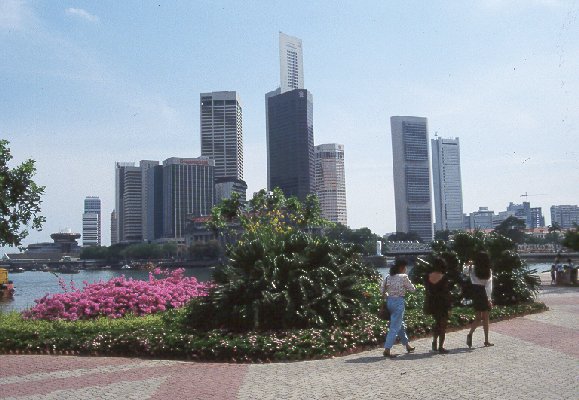 Ik ben nog maar een keer in Maleisië geweest, gedurende twee weken, als onderdeel van een reis van een half jaar, van Indonesië, Singapore, Maleisië, Thailand, Hongkong, China en Pakistan.
Route: van Jakarta (Indonesië) en Singapore naar Malacca, Seremban, Kuala Lumpur, Cameron Highlands, Taman Nagara National Park, Kuala Terengganu, Kota Bharu en van daar naar Thailand.
Anekdote
Over Singapore kan ik kort zijn: een prachtige stad, maar gemaakt voor robots en niet voor mensen. Alles wordt hier blinkend schoon gehouden, en er zijn vele wetten om dit zo te houden. Hoge boetes voor het betreden van grasveldjes (hoewel de politie in burger daar wel op zit, om je uit te dagen), hoge boetes voor het bezit van kauwgum, geen peuken in de goot, boetes voor het trekken aan de noodrem, alle waarschuwingen inclusief de extreme hoogte van de boete.
Er is veel te zien in Singapore. Het chinese centrum is meer chinees dan China zelf, nadat daar veel cultuur verwoest is tijdens de culturele revolutie.
 In de chinese wijk van Singapore heb ik een chinese tempel
bezocht. Daar bevond zich een vitrine met een soort grafstenen, maar dan van hout, en veel kleiner. Honderden naambordjes
, in twee maten: de grote en de kleine. De chinezen geloven namelijk dat er twee hemels zijn: de eenvoudige hemel en de luxe versie daarvan. De familie moet lang sparen om een naambordje te kunnen upgraden, en daarmee het familielid te laten verhuizen naar de luxe hemel.
In de chinese wijk van Singapore heb ik een chinese tempel
bezocht. Daar bevond zich een vitrine met een soort grafstenen, maar dan van hout, en veel kleiner. Honderden naambordjes
, in twee maten: de grote en de kleine. De chinezen geloven namelijk dat er twee hemels zijn: de eenvoudige hemel en de luxe versie daarvan. De familie moet lang sparen om een naambordje te kunnen upgraden, en daarmee het familielid te laten verhuizen naar de luxe hemel.
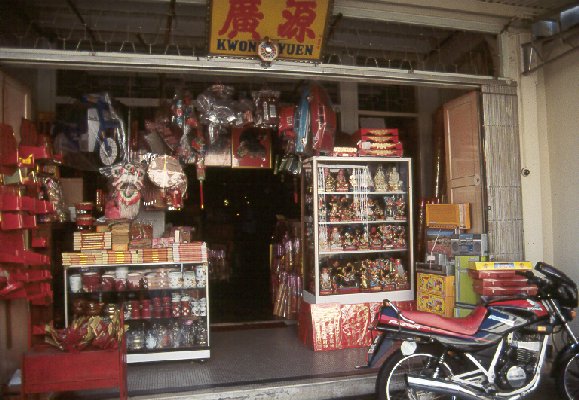
Ook grappig was de winkel met begrafenis-requisieten, zie hiernaast. Bij de begrafenis worden allerlei kadootjes verbrand, die dan via de rook bij de overledene aankomen. Het winkeltje had papieren auto's, papieren brommers, zelfs papieren huisbedienden. En natuurlijk veel namaak-geld. Mocht de overledene onverhoopt toch in de hel aankomen, dan zal hij vast blij zijn met de miljoenen dollars aan Hell Banknotes, waarmee hij zich vrij kan kopen uit de hel. Die chinezen denken werkelijk aan alles.
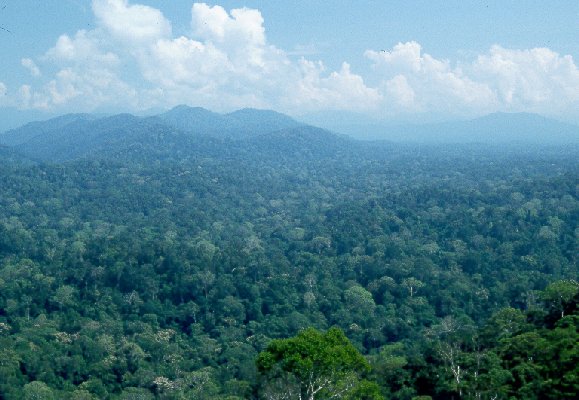 In het midden van Maleisië ligt een grote jungle, ik geloof dat dit Taman Negara heet. Dit is primary jungle, de zeldzame vorm van het dichtstbegroeide oerbos. Via een boottocht over door boomblaadjes compleet bruigekleurd water, kom je in het kamp. Dit is een luxe set van bungalows op een vlakje aan de oever van de
rivier
. Maleisië is heel goedkoop, zeker als je net uit Singapore komt, en deze luxe kan er wel vanaf. Bij het kamp zijn paden uitgezet door de jungle, want zonder pad kom je er echt niet door. De meeste toeristen hebben geen conditie, want ik denk dat ik alle uitgezette paden zeker twee keer gelopen heb in deze drie dagen, waar een aantal benoemd was als 'dagtocht'.
In het midden van Maleisië ligt een grote jungle, ik geloof dat dit Taman Negara heet. Dit is primary jungle, de zeldzame vorm van het dichtstbegroeide oerbos. Via een boottocht over door boomblaadjes compleet bruigekleurd water, kom je in het kamp. Dit is een luxe set van bungalows op een vlakje aan de oever van de
rivier
. Maleisië is heel goedkoop, zeker als je net uit Singapore komt, en deze luxe kan er wel vanaf. Bij het kamp zijn paden uitgezet door de jungle, want zonder pad kom je er echt niet door. De meeste toeristen hebben geen conditie, want ik denk dat ik alle uitgezette paden zeker twee keer gelopen heb in deze drie dagen, waar een aantal benoemd was als 'dagtocht'.
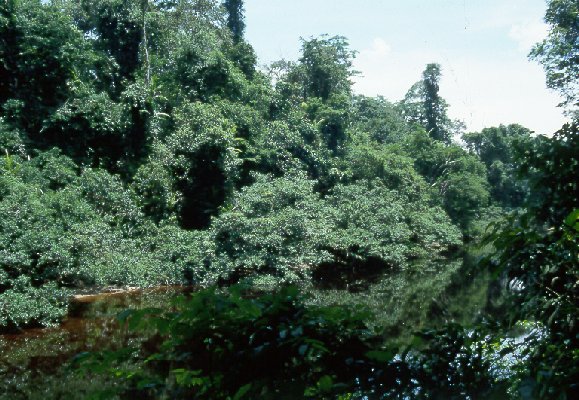 De jungle is hier erg dicht. De hoogste bomen zijn zeker dertig tot veertig meter hoog. Daaronder heb je weer andere begroeiing, en dat loopt laagsgewijs door, zodat het op de grond zo donker is dat de camera geen foto's kan maken. Alleen af en toe zie je een gaatje waar licht door valt. Onder de humuslaag van gevallen bladeren en takken schittert strand-zand. Zo'n tien tot twintig centimeter onder de jungle is er alleen dode grond. Ziet er kwetsbaar uit. De jungle zelf is groen, groen en groen. Werkelijk alles wat je ziet is plantaardig. Het krioelt er van de beesten, waar je niets van te zien krijgt door al die bladeren. Je kunt wel prachtige vogelzang horen, maar zien: ho maar. Het is er warm, en heel vochtig. Met de minste inspanning is het zweten, de druppels hangen aan mijn neus. Doet best wel zeer aan mijn ogen, dat zoute zweet dat langs mijn voorhoofd naar mij ogen gutst. Net als in de woestijn moet je hier zeven liter water per dag drinken. Op de foto hieronder is dat die witte tas waar mijn arm op rust.
 In die hitte vraag je je misschien af waarom ik geen luchtiger kleren en sandalen draag. Nou, dat dachten andere toeristen ook. Allereerst sterft het er werkelijk van de muggen, inclusief die malaria-types. Alleen in rubberplantages heb ik er meer gezien per kubieke meter, dan praat je al snel over honderden grammen mug per m3. Daarnaast heb je in de jungle ook veel bloedzuigers. Voel je niks van. Er kriebelt iets lichtjes in je nek, en je gaat er met je hand overheen. Als je je hand terugtrekt zie je dat die kompleet bedekt is met bloed. Hoe die beesten in je nek komen is een raadsel, maar geloof me dat je daarna voorgoed een grote zakdoek om je nek knoopt. Ze beginnen als nietige worpjes, 3 cm bij 3 mm., maar het worden joekels zo groot en dik als je pink zodra ze met je klaar zijn. Hetzelfde voorzorg met broekspijpen-in-de-sokken. Indiana Jones was niet helemaal gek. Hoed met een brede rand, voor schaduw en tegen insecten zoals teken, spinnen en bloedzuigers. Dikke hoge bergschoenen, want er zijn ook miljoenpoten (inderdaad, de grotere broer van de duizendpoot), die zo groot worden als een flinke kroket, met aan hun achtereind een indrukwekkende stekel met gif, die ze in je hak boren als je alleen sandalen aan hebt. Zo'n steek houdt je zeker twee weken aan het toilet gekluisterd. De steek van een teek kan niet veel kwaad, behalve als je hem in een reflex van de hand slaat. Dan blijft het kopje zitten en dat kan heel snel geweldig zweren. Krabben op plaatsen waar die miljarden muskieten je gestoken hebben levert ook snel pus en pijn op. Ik denk dat ik mijn punt wel gemaakt heb over mijn kleding.
De jungle van maleisië is beroemd om zijn tijgers. Omdat die voornamelijk bij schemer en nacht jagen, is er een uitkijktoren waar je na zonsondergang naar beneden kan kijken. Uiteraard niet 1 tijger gezien. De jungle is ook beroemd om zijn Rafflesia (de grootste bloem ter wereld, een insecten-eter en daarom mijn vriend). Wederom: niet eentje gezien. Er zijn ook heel bijzondere vogels, maar ik merk dat ik mezelf herhaal.
Het noorden van Maleisië heeft geweldige standen, wat rust en (gebrek aan) toerisme betreft zeker beter dan Pukhet of Koh Samui in Thailand. Maar die jungle overtreft alles. Echt een aanrader.
Na Maleisië doorgereisd naar Thailand
Malaysia
I have only been to Malaysia once, for two weeks, as part of a six-month trip through Indonesia, Singapore, Malaysia, Thailand, Hong Kong, China, and Pakistan.
Route: from Jakarta (Indonesia) and Singapore to Malacca, Seremban, Kuala Lumpur, Cameron Highlands, Taman Nagara National Park, Kuala Terengganu, Kota Bharu and from there to Thailand.
Anecdote
I can be brief about Singapore: a beautiful city, but made for robots and not for humans. Everything here is kept sparkling clean, and there are many laws to keep it that way. High fines for trespassing on lawns (although plainclothes police do sit there, just to provoke you), high fines for possessing chewing gum, no cigarette butts in the gutter, fines for pulling the emergency brake, all the warnings, including the extremely high fines. There is much to see in Singapore. The Chinese center is more Chinese than China itself, after much culture was destroyed there during the Cultural Revolution.
252
In the Chinese quarter of Singapore, I visited a Chinese temple. There, there was a display case with a kind of gravestones, but made of wood, and much smaller. Hundreds naambordjes
, in two sizes: the large and the small. The Chinese believe that there are two heavens: the simple heaven and the luxury version thereof. The family must save for a long time to be able to upgrade a nameplate, and thereby allow the family member to move to the luxury heaven.
Also funny was the shop with funeral props, see picture next to this text. At the funeral, all kinds of gifts are burned, which then reach the deceased via the smoke. The little shop had paper cars, paper mopeds, even paper house servants. And, of course, lots of fake money. Should the deceased unexpectedly end up in hell after all, he will surely be happy with the millions of dollars in Hell Banknotes, with which he can buy his way out of hell. Those Chinese really think of everything.
In the middle of Malaysia lies a large jungle; I believe it is called Taman Negara. This is primary jungle, the rare form of the densest primeval forest. You reach the camp via a boat trip across water completely brown-colored by tree leaves. This is a luxurious set of bungalows on a small plain on the bank of the
river.
Malaysia is very cheap, especially if you have just arrived from Singapore, and this luxury is certainly affordable. At the camp, paths have been marked out through the jungle, because you really wouldn't get through without a path. Most tourists are out of shape, because I think I walked all the marked paths at least twice in these three days, several of which were designated as 'day trips'.
The jungle here is very dense. The tallest trees are at least thirty to forty meters high. Below that, there is other vegetation, and it continues in layers, making it so dark on the ground that the camera cannot take any photos. Only occasionally do you see a small gap where light shines through. Beneath the humus layer of fallen leaves and branches, beach sand sparkles. About ten to twenty centimeters below the jungle, there is nothing but dead soil. It looks fragile. The jungle itself is green, green, and green. Absolutely everything you see is plant-like. It teems with animals, none of which you can see because of all the leaves. You can hear beautiful birdsong, but seeing them? Forget it. It is hot and very humid. With the slightest effort, I am sweating; droplets hang from my nose. It hurts my eyes quite a bit, that salty sweat gushing down my forehead to my eyes. Just like in the desert, you have to drink seven liters of water a day here. In the photo below, that is the white bag my arm is resting on.
In this heat, you might wonder why I am not wearing lighter clothes and sandals. Well, other tourists thought the same thing. First of all, it is absolutely swarming with mosquitoes, including those malaria types. Only in rubber plantations have I seen more per cubic meter; you are easily talking about hundreds of grams of mosquito per m³ there. Additionally, there are a lot of leeches in the jungle. You don't feel a thing. Something tickles your neck slightly, and you run your hand over it. When you pull your hand back, you see that it is completely covered in blood. How those creatures get onto your neck is a mystery, but believe me, you will tie a large handkerchief around your neck forever after that. They start as tiny little worms, 3 cm by 3 mm, but they become whoppers as big and thick as your little finger once they are done with you. The same precaution applies to tucking trouser legs into socks. Indiana Jones wasn't entirely crazy. A wide-brimmed hat, for shade and against insects like ticks, spiders, and leeches. Thick, high hiking boots, because there are also millipedes (indeed, the bigger brother of the centipede), which grow as big as a hefty croquette, with an impressive venomous spine at their rear end that they bore into your heel if you are only wearing sandals. A sting like that will keep you glued to the toilet for at least two weeks. A tick bite isn't very harmful, unless you swat it off your hand in a reflex. Then the head stays in, and that can fester terribly very quickly. Scratching in places where those billions of mosquitoes have bitten you also quickly results in pus and pain. I think I've made my point about my clothing.
The jungle of Malaysia is famous for its tigers. Because they hunt mainly at dusk and night, there is an observation tower where you can look down after sunset. Naturally, I didn't see a single tiger. The jungle is also famous for its Rafflesia (the largest flower in the world, an insectivore and therefore my friend). Again: didn't see a single one. There are also very special birds, but I notice I am repeating myself.
The north of Malaysia has amazing beaches; in terms of peace and (lack of) tourism, certainly better than Phuket or Koh Samui in Thailand. But that jungle surpasses everything. Highly recommended.
After Malaysia, traveled on to Thailand